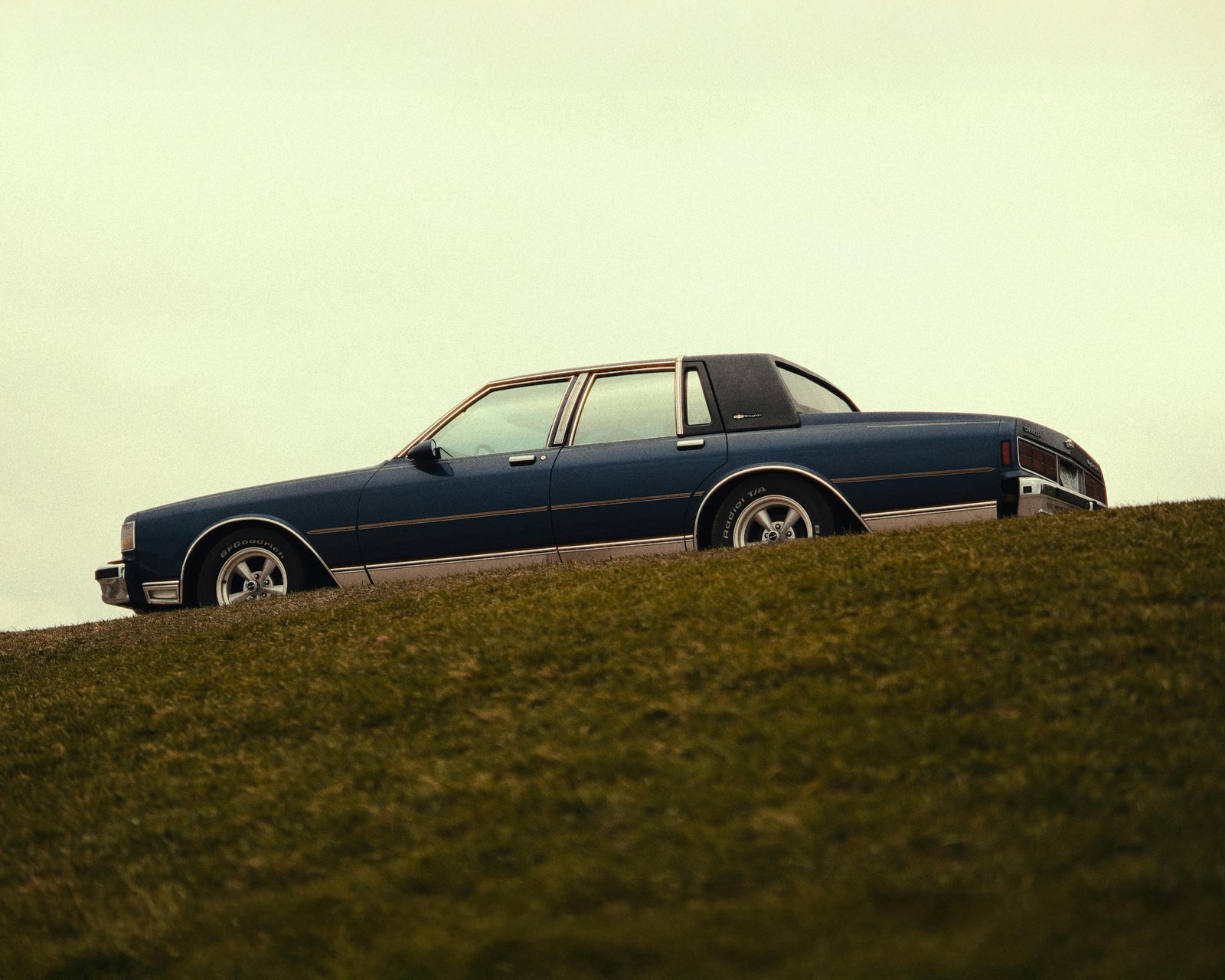
My mother’s driving along the freeway like it’s her first time, like she’s being tested: hunched over the steering wheel, hands at ten and two, eyes squinting with concentration. Her nose scrunches and she does a double-take over her shoulder every time she has to switch lanes. Sitting in the passenger seat, I’m reading an old Harlequin paperback I found in the glove compartment. But none of the words seem to process, and I find myself rolling my eyes more often than usual at the characters’ unabashed desire for each other, skimming over the pages. Sighing, I close the book and set it aside, my attention gravitating toward my mother.
My gaze lingers on her, and while I often stare at my mother with admiration, I can’t help but find the sight of her driving quite odd and uncanny. She always drove me around when I was a kid, before she married Roger—Roger hired a driver, and she hasn’t been behind the wheel since. I’m especially fond of Mr. Charles at this moment, who’s always aloof and collected. His driving never stresses me out the way Mother’s is beginning to. In fact, Mr. Charles was supposed to facilitate our journey this morning, but Mother insisted she get behind the wheel, dismissing him for the day.
We’re headed to St. Lawrence’s Sanitorium for Eating Disorders. It is an hour’s drive north of our home, and I heard it was a convent some decades ago. There is curious lore behind its transformation into a sanatorium—a local legend of sorts. Apparently, a slew of nuns had begun to develop severe bulimia, and the head nun thought it a grave waste of food. So she enlisted a doctor to straighten them out, and it was a matter of time before families sent their food-sick daughters to St. Lawrence’s, hoping to set them right, too. As my mother and I inch closer to the sanatorium, I wonder what the living conditions of such a place will be. Do they watch your every move—to make sure you eat and digest your food properly? Do they give you any special medicine? Will you have a bedroom, or do all the women sleep in bunk beds in rows, like prisoners? How similar will the sanatorium be to a prison?
I contemplate the mystery of our destination—I’ve only heard about it in passing, but have never known anyone to be admitted to it. I hope it’s only frightening in rumour and will prove harmless and serene—merely a place of healing and rejuvenation. Only time will tell: half an hour, I figure, glancing at the radio clock on the dashboard—though time creeps by much slower than usual this morning, with my mother behind the wheel. I open the glove compartment and pull out a packet of gum, popping open a piece. Mother wordlessly holds out her hand and I drop a second piece into hers.
After a few minutes, the car slows in speed, and my mom squints ahead as we come upon a slew of cars ahead, packed in traffic. Her face falls; we left the house early in an attempt to beat the morning rush, to my dismay since I barely slept last night. I notice my mother’s chest rise and fall faster, and the furrow between her brows—usually faint—begins to pronounce itself with anxiety. I stare out the window at a passing family of geese, a mother and her delightfully fluffy babies, wishing I’d hatched from an egg instead.
“Damn it,” my mother mutters, tapping a manicured finger against the steering wheel.
“It’s alright,” I say, reaching over to turn on the radio. “Here.”
Then Billy Joel begins to sing a familiar happy tune out of the stereo, to my pleasure and surprise. I remember when it was just my mother and I, a little girl then, and we’d have dance parties every so often. I miss our old record player. Roger replaced it with a boombox; sure, it’s louder with better sound, but it pales in comparison to the record player’s staticky melodies. The memory of my mother spinning me around our tiny apartment, jumping with me to Elvis and swaying with me to Fleetwood Mac, brings a grin to my face. Despite myself I begin to shimmy in my seat, nudging my mother with my elbow, coaxing her to join. She smiles slightly, still nervous, but after a minute she sways along with me.
As my mother and I head toward impending doom and an inevitable parting, while dancing to the songs of my childhood, I find myself feeling an eerie combination of joy and sorrow.
I want to savour this moment, this fleeting morsel of peace and nostalgia we’ve found ourselves with. Who knows when it’ll happen next?
As we pull off of the highway, the reality of my present situation begins to set in. I’ve always considered St Lawrence’s to be as real as the haunted house in Poltergeist, a mere mirage of ghostly tales. I tap my fingers together, fidgeting as I stare ahead—soon we will be face to face with the secluded fortress.
We turn into a road shaded by grand oak trees, and our trail is bumpy. I develop a headache, a cherry on top of the steaming pile of anxiety I’ve become. The view in front of the windshield seems to stay the same, and I find it hard to tell how long we’ve been driving through this forest. My mother brought a map in case we got lost, but there isn’t anywhere else to turn: surely, I figure, we will reach the sanitorium.
We finally slow down when we approach a massive black gate: guarding it is a short, stout old man who sits on a stool, reading a newspaper. My mother rolls her window down—he has not so much as looked up from his task, appearing oblivious to our arrival.
“Hi, sir,” calls my mother, sticking her head out of the window. “It’s Graham.”
The guard grunts lowly in reply and stands up to open the gate. “Thank you!” my mother waves at the guard, overly cheery as she drives in. My eyebrow raises involuntarily.
And here is St Lawrence Sanatorium: a great dwelling of three or four stories, towering over our small car, shrouded in great trees. A curious sight greets me as I step out of the vehicle, which my mother parked on a patch of grass near the front doors: another family of geese trotting away from the house. The mother and father lead a group of smaller birds, who clumsily follow, waddling. One gosling lingers a few metres behind: it leaves a trail of blood, and seems to limp on one leg. My heart pangs for the poor little goose, but there is, of course, nothing I can do. I wonder if there’s someone around who will notice it and help.
My mother and I walk hand in hand toward the front doors; I sense her ever-growing anxiety and put her hand in mine, hoping it’ll be of some comfort. That, and I’m bracing myself for devastation at our inevitable parting. The building emanates a foreboding aura which doesn’t help. I can’t see a drop of saturation or decoration, not a single flower standing in the garden, nor a window open or curtain undrawn.
The door swings open as we approach it, before we get a chance to knock. Facing us is a burly woman who I estimate to be a bit older than my mother. She wears a sweater the colour of dijon mustard, which makes her skin look blueish and wan. She looks deeply unhappy, her resting expression and refusal to say hello striking me as unpleasant, but maybe I’m projecting.
“We’re here for intake,” my mom says after a moment of awkward silence. “Graham?”
Mother nods.
“Which one of you is Lucy?” The mustard lady scrunches her nose, peering back and forth between us.
My mother steps forward. I look at her, her hands clasped behind her back, resembling a child called to the front of the classroom. I knew I would cry at some point, I cry about everything, but when my mother passes her car keys over to me, and enters the building fully, it hits me like a boulder would a dam. I turn away abruptly and let the tears stream down my face. I walk back to the car, feeling flurries of snow melt with my tears. I hear the honks of the geese flying off, and see that the injured gosling stays limping, still trying to catch up.
— FIN —