A ferry was once the only way to traverse the broad body of water called the Chesapeake Bay from the Delmarva Peninsula to the military, cultural and transportation hub of Norfolk-Hampton Roads, Virginia. After you left behind the docks at Little Creek, there was nothing visible but a vast expanse of water on all sides, and you were free to pretend you were adrift in the North Atlantic. Now, of course, there is the superb Chesapeake Bay Bridge-Tunnel; however, that engineering feat was still a decade away.
There was more than just water separating factors in the South during the 1950s.
We were traveling to my uncle's wedding in Norfolk. Halfway through the two-hour passage, I informed my mother that I was going to the restroom. As I turned away, she grabbed my arm and said in a loud whisper, "Make sure you read the signs before you go in."
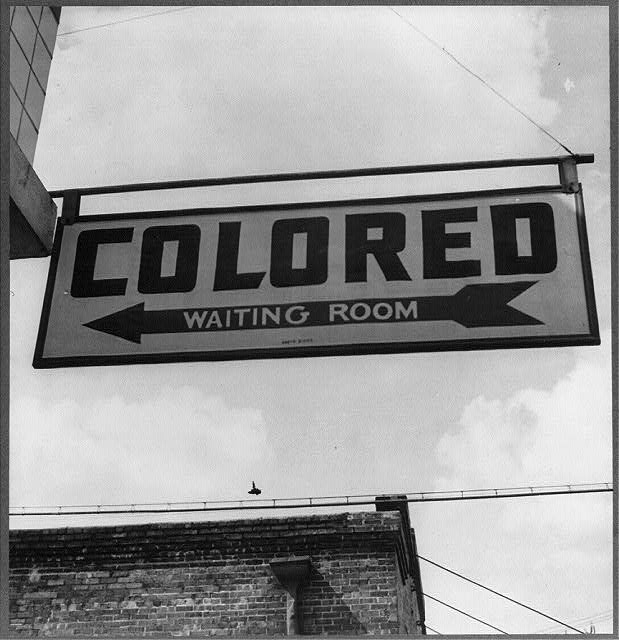
Although only eight at the time, I was old enough to understand that the customs of Virginia and other states were singular and sometimes peculiar. As a New York City girl, I knew what she meant. Approaching the paired entries, I silently read "White Ladies' Room" to the left. The door on the right said “Colored Women's Room.” The first was neatly painted and did not support several days' worth of smudged fingerprints. The other was, well, clearly used; as though wiping them both simultaneously was some sort of overreaching maintenance undertaking, and investing in a few extra strokes of paint was an insult to the vessel's trip economy.
It probably took me fifteen years to recognize the true insult inherent in those signs.
In the mores of mid-twentieth-century America, most properly raised girls were trained to be “ladylike.” This is now a passe notion, but it was important to our grandmothers, and maybe even our mothers. Being a lady meant comporting herself properly, conforming to certain behavioral and attire standards, and, above all, observing public morals.
A Lady would:
• see that her skirt covered her knees (and that the knees were continually kept together),
• always possess a clean handkerchief (or tissue) in her purse,
• make certain the seams of her stockings were straight,
• keep a sharp eye out for the showing of her slip from beneath her skirt hem.
A Lady did not:
• speak too loudly,
• interrupt older people,
• wear white before Memorial Day (nor after Labor Day),
• swear (except mentally),
• wear lipstick until she was at least fourteen,
• date before she was sixteen.
Ladies wouldn't hear of sex without an engagement ring. (Or so we pretended.)
It all seems somewhat silly now from the far side of half a century, but they were important factors in those days.
However, what those Jim Crow era signs actually said was that only White women could be 'ladies.' It was a subliminal insult, though I didn't recognize it at the time. Black women, while they might follow the same standards, wearing their stylish hats to church and sporting sparkling dress gloves, could not be ladies in the truest sense. And despite it appearing innocent enough, these are the subtle, subjective insults that we may be perpetrating daily on those whose races and nationalities differ from the white 'power' plurality.
We might smugly believe we've gone past the point where we should pause and think about what we are going to say—its blatant overtones and unintentional undertones. That would be the ladylike and humanity-oriented action to take.
The years have moved on, and we like to believe we've progressed. It is only overdue by more than 150 years.
But have we really grown enough?
Having lived through those times, I now realize how many of the rules we followed then were purely absurd—not just those of clothing and social bearing. Our denigrating attitude toward those who looked different from us seems to be the factor that so often engenders our dislike of others. It is a perverse sort of tribalism—leftover ludicrousness from when we were a less evolved species.
We are reminded that, at the most basic level—genomic—human beings are 99.6% the same, regardless of our color, ethnicity, national origin, gender or language. The externals are just wrapping paper.
Stay in the niche. There's more where this came from on our newsletter...subscribe now.